The Interessengemeinschaft Farben (I.G. Farben) was established in 1925 as a merger of the major German chemical companies, forming one of the largest chemical and pharmaceutical conglomerates in the world at the time.
During the period of Nazi Germany, the company continued to expand, partly through the expropriation and incorporation of Jewish-owned businesses. It supported the regime through industrial production, including the manufacture of Zyklon B, which was used in extermination camps such as Auschwitz concentration camp. In addition, I.G. Farben developed synthetic rubber known as Buna in an effort to reduce dependence on imported raw materials. The company was also directly involved in the financing and operation of the Monowitz labour camp (Auschwitz III).
After the Second World War, I.G. Farben was dissolved, and several of its constituent companies re-emerged as independent firms, including well-known names such as BASF, Bayer, and Hoechst AG.
Sources
Buildings

Berlin, Germany
I.G. Farben Aceta
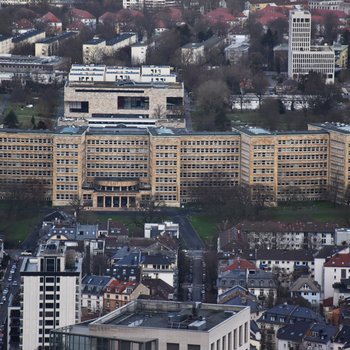
Frankfurt (Main), Germany
I.G. Farben Building