Margarete Schütte-Lihotzky studied in Vienna from 1915 to 1919. As the newly founded Republic of Austria was actively engaged in social housing, particularly in Vienna, she quickly turned her attention to the design of small, simply organised living spaces, in other words, to rationalisation.
She became acquainted with Ernst May through Adolf Loos and went on to write articles for May’s journal Schlesisches Heim. As May pursued a strongly standardised approach in his planning work in Frankfurt am Main, he invited her to join his team.
Among her many designs, she is best known for the Frankfurt Kitchen, the prototype of the modern fitted kitchen. While in Frankfurt, she met the architect Wilhelm Schütte; the two married in 1927.
Due to the political situation, she left Germany and, between 1930 and 1937, worked primarily in the Soviet Union, where she designed nurseries and children’s furniture. Via Paris, she and her husband later moved to Istanbul, where they taught and developed standardised designs for village schools.
A member of the Communist Party, she was also involved in planning resistance activities in Austria. However, she was arrested by the Gestapo in 1941. She narrowly escaped the death penalty but was imprisoned in the women’s penitentiary at Aichach, Germany, where she was liberated by US troops in April 1945.
Until 1947, she worked in Sofia, Bulgaria, as in post-war Austria, then governed by Social Democrats, she received no commissions due to her firm communist convictions. As the political climate gradually changed, she was able to return to Vienna and, in 1949 and 1950, design her first municipal housing projects once again. She worked until 1969.
Since she became 80 years, her work was recognised in a number of exhibitions. On the occasion of her 100th birthday, Margarete-Schütte-Lihotzky-Platz in Vienna was named in her honour. Today, she is regarded as a role model by women, architecture enthusiasts, and those committed to political resistance.
Sources
Buildings
Frankfurt (Main), Germany
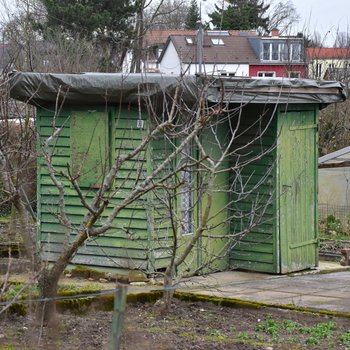
Garden shed Frankfurt