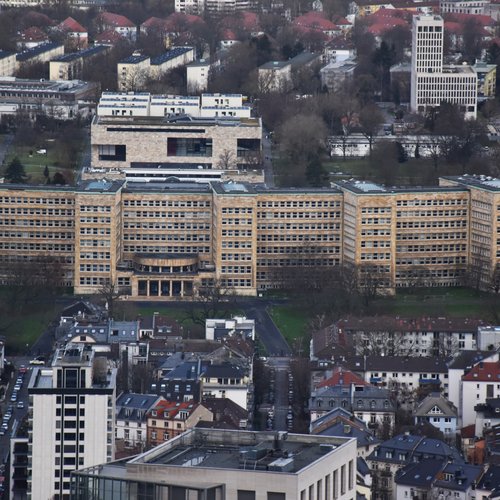
A vast building intended to express the power and ambition of the leading chemical companies was commissioned following a design competition won by Hans Poelzig. Although not especially modern in style, the design incorporates elements of a restrained, grid-based Neoclassicism. The regimented, grid-like structure is characteristic of Poelzig’s architectural language.
The building’s monumentality is further emphasised by six projecting structures, combining features of avant-corps and tower-like forms. This construction method is known in German as a Kamm or Finger (comb/finger), creating a series of small internal courtyards. At the centre, these frame the main entrance, designed as a severe and formal portico, which leads directly into the interior staircase.
On the northern side, the entrance takes the form of a circular structure that is much more clearly aligned with modernist principles. Large expanses of glass and the absence of ornamentation are the most striking indicators of this shift. The slightly curved main building itself is constructed with a steel frame infilled with brick and clad in travertine.
Inside, the use of high-quality, expensive materials was intended to reflect the prestige and status of the corporations it housed.
Not far from the main complex stands to the north the so-called Casino, which originally served as both a staff canteen and a social venue for senior management. During its period of military use, it functioned as an officers’ mess, and today it once again operates as a catering and hospitality venue.
The building is often described as having nine storeys. However, a closer inspection suggests otherwise: on the southern side, eight upper floors can be counted, while on the northern side there are seven. It is therefore likely that the basement level has been included in the total count without being explicitly mentioned.
If you know, how to say comb or finger structure in English, please let us know.