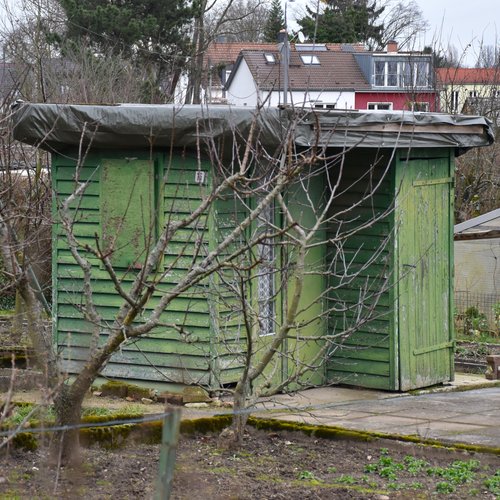
Considerable thought has been given to gardens in Germany. These ideas gradually developed into regulations: fence height, permitted uses of the plot, toilet facilities, and so on. Naturally, this process of standardisation also extended to the garden shed itself.
Concepts for gardens in large industrial cities emerged in the 19th century. They allowed people to spend time in the fresh air and, to some extent, become self-sufficient within the urban environment.
We are based in Leipzig, where the first garden colonies of the Schreber type were established, and where industrialists were already providing standardised garden sheds. The Krause type, produced by the company of the same name, is a model dating from the turn of the century.
Building on these ideas, and in connection with construction activity in Frankfurt am Main, Margarete Schütte-Lihotzky developed the garden hut of the Neues Frankfurt movement. With its clean lines and minimalist space, in which it was even possible to sleep, it fulfilled the core idea of the minimum dwelling.
Originally, 66 garden sheds were available for the residents of Römerstadt. They were primarily used by those living in the larger houses within the estate, which did not have gardens of their own.
The most recent restoration (2023–24), during which the original roof was reinstated and the colours reapplied in keeping with the original scheme, presents the shed in its authentic state. Significant support was provided by the German Foundation for Monument Protection (Deutsche Stiftung Denkmalschutz) in order to preserve this piece of human heritage.
In 2025, the Ernst May Society (Ernst-May-Gesellschaft e. V.), as the organisation responsible for the garden shed, was awarded the Volunteer Award of the Hessian Heritage Conservation Prize following its restoration and return to its original condition. The award comprised €2,500, as well as a bronze plaque and a certificate.